


The short answer
Most wine cooler problems, including warm zones, frost, drain issues, and error codes, come from a fan, sensor, control board, gasket, or blocked airflow, and these are usually repairable on a high-end unit. We diagnose built-in Sub-Zero, Viking, and Thermador wine storage at your home and explain the repair before starting work.
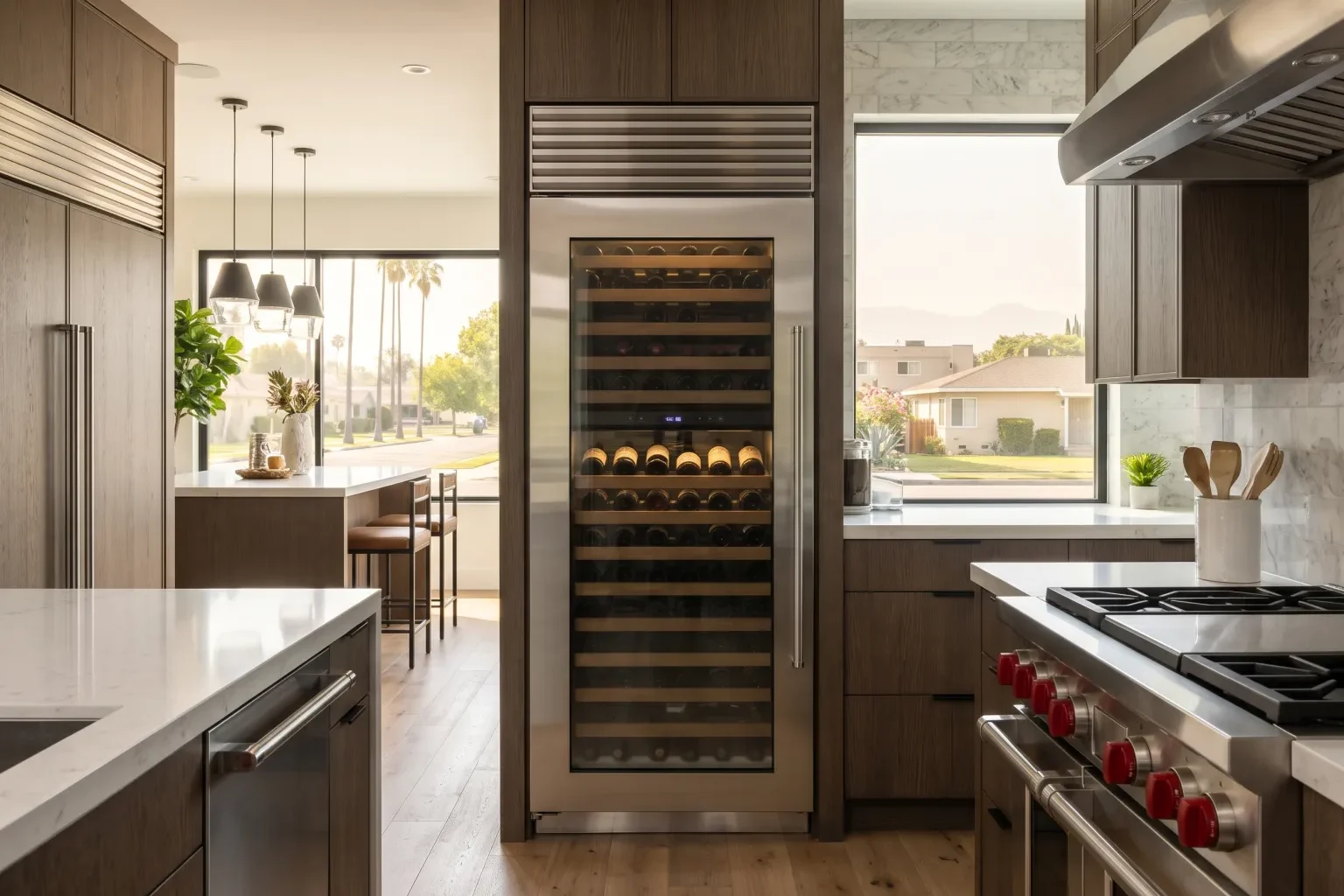
A wine cooler that drifts a few degrees warm, cycles loudly, or fogs up behind the glass puts a collection at risk long before it stops running. We repair built-in, integrated, and freestanding wine storage for homeowners in North Hollywood and nearby cities. Most of our work is on Sub-Zero units, and we also service the Viking and Thermador columns and undercounter models that often sit beside a Wolf range in the same kitchen. A technician comes to your home, finds the actual fault, and explains your options before any work starts.
Issues we fix
Wine storage is less forgiving than a refrigerator. A swing of a few degrees, or frequent temperature cycling, can affect how wine ages. If you notice any of the following, it's worth having the unit checked before the problem gets worse.
- Not cooling, or holding a temperature several degrees off the setting
- One zone of a dual-zone unit running warm while the other is fine
- Frost or ice building up on the rear wall or evaporator cover
- Condensation or fog on the glass door, or water on the floor
- Not draining, or a musty smell from a clogged drain line
- Error codes, a flashing display, or a control panel that won't respond
- Compressor running nonstop, short-cycling, or not starting
- Buzzing, clicking, or rattling from a fan
- Interior lights out, or a door that won't seal or close on its own
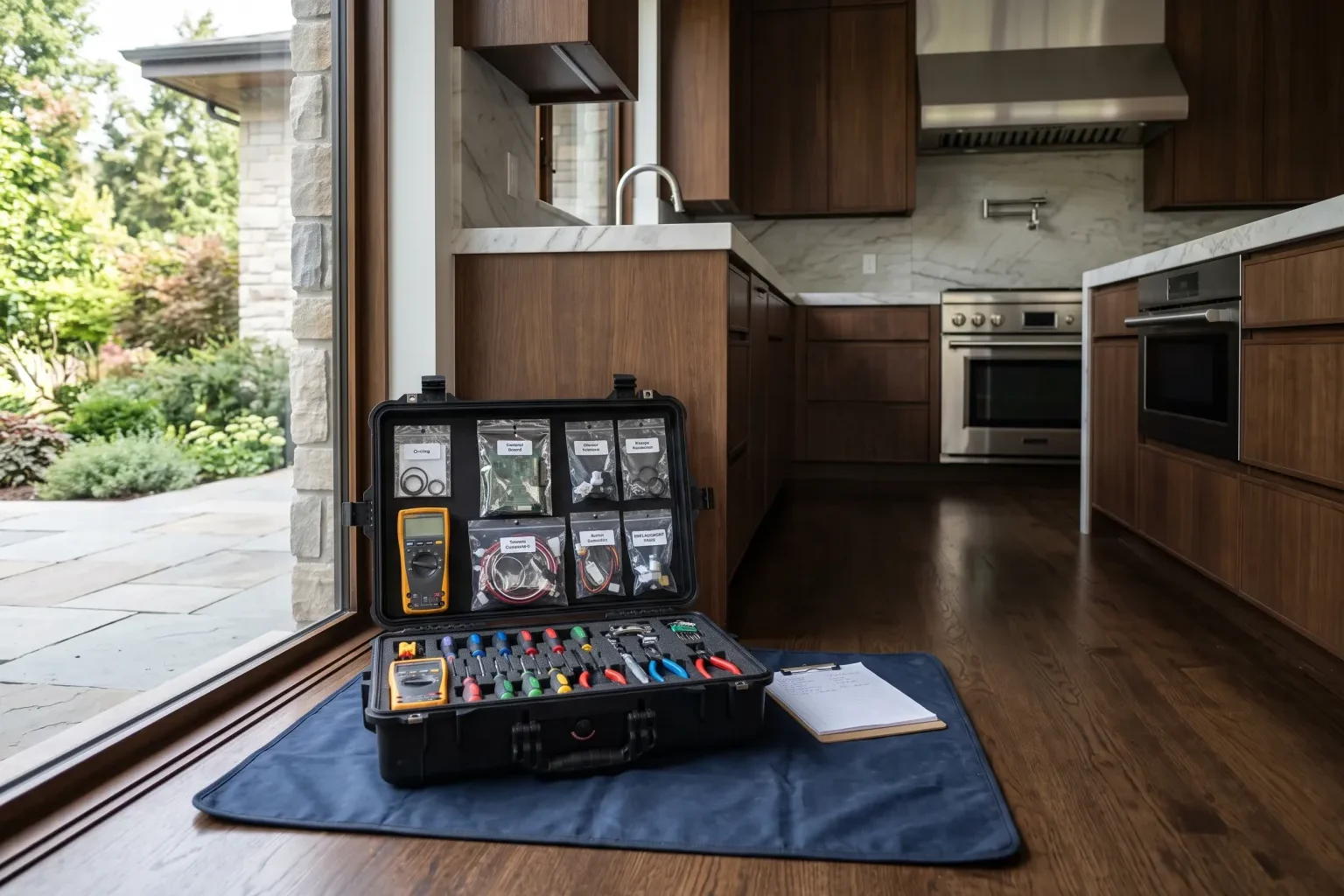
What our technician checks on a built-in unit
We start by confirming the problem. We place a separate thermometer in each zone and compare its reading with the display, because a faulty temperature sensor can make a healthy unit look broken, and the reverse is also true.
On a built-in or professional-style unit, airflow comes next. Most built-ins take in and exhaust air through a front grille near the floor. Dust, pet hair, or a rug pushed against that grille makes the condenser work harder. That matters here because Los Angeles valleys, including the San Fernando Valley, run much hotter in summer than areas near the coast, and fall Santa Ana winds can bring hot, dry spells. A unit that keeps up in spring can fall behind in August.
From there we check the condenser and evaporator fans, the defrost function, the thermistors, and the control board and user interface. We inspect the door gasket, hinges, and alignment, since a heavy glass or panel-ready door that sags even slightly can leak cold air. We clear and test the drain path. If those all check out, we move to the sealed system and look at compressor operation, the start components, and signs of a refrigerant leak. We also look at how the unit sits in the cabinetry, including clearances, leveling, and any heat sources nearby.
How Sub-Zero, Viking, Wolf, and Thermador models differ
Sub-Zero wine storage is usually built in or fully integrated, often with two or more zones that each have their own sensors and controls. On these units we most often look at temperature sensors, control electronics, evaporator fans, door gaskets, and condenser airflow in tight cabinet installations. Older units can also develop sealed-system problems that take more time to diagnose.
Viking makes undercounter wine coolers and full-height columns. Here the usual suspects are fans, controls, and the seal and hinges on glass doors that open many times a day. On older models, parts availability can affect the repair plan, so we check that early.
Thermador wine columns are often panel-ready and built in flush with the surrounding cabinets. Electronic controls and sensors are common points to check, and the weight of a custom door panel can affect hinge alignment and gasket contact over time.
Wolf is a cooking brand and doesn't make wine storage, but many of the kitchens we visit pair a Wolf range or wall oven with a Sub-Zero wine column. When a wine unit sits next to a heat source and the cabinetry doesn't vent well, it can carry a heavier load. We look for that, and we also repair the Wolf appliances in the same kitchen.
Tell us what your appliance is doing.
Repair or replace a high-end wine cooler?
High-end built-in wine storage is designed for a long service life, and repair is usually the sensible choice when the cabinet, liner, and sealed system are sound. Replacing a fan, sensor, control board, or gasket costs far less effort and disruption than replacing an integrated unit. A new unit has to match your opening, and custom panels may need to be refitted or remade.
Replacement starts to make sense in a few cases. One is when the compressor has failed on an older unit. Another is when a refrigerant leak sits inside foamed-in tubing that can't be reached. Replacement is also worth considering if critical parts are discontinued or the interior liner is cracked. When a repair isn't worth doing, we'll tell you plainly and explain why.
What affects the cost of a wine cooler repair
We give you a quote after diagnosis, before any repair work begins. The main factors are:
- The fault itself. A clogged drain or a failed fan takes less time than sealed-system work, which needs extra equipment and steps.
- The part. Some parts are commonly stocked, while others have to be ordered from the manufacturer or are hard to find for older models.
- Access. Pulling an integrated unit out of custom cabinetry, removing panels, or working around trim takes more time and care.
- Return visits. If a part has to be ordered, the repair is finished on a second trip.
How a visit works
When you contact us, describe what you're seeing and share the model and serial number if you can find them. On most wine units they're on a label inside the cabinet, often on a side wall or the ceiling. This helps us bring the right parts.
At the appointment, the technician diagnoses the unit, walks you through what failed and why, and gives you a quote. If you approve and the part is on hand, we complete the repair during that visit. If not, we order it and schedule a return. Before we leave, we confirm the unit is cooling and cycling normally. If your bottles need to come out while we work, plan for a cool, dark spot to hold them.