


The short answer
Most ice maker problems come from a clogged filter, a failing water inlet valve, a frozen fill tube, a worn ice maker module, or a freezer that isn't cold enough. These parts can usually be repaired or replaced without replacing a high-end built-in unit. Our technician tests each part to find the actual cause before recommending any work.
When the ice bin stays empty, or fills with hollow, cloudy, or clumped cubes, the cause is usually one of a few parts in the water supply, the ice maker itself, or the cooling system. We repair ice makers in built-in refrigerators and in freestanding undercounter ice machines for homeowners in North Hollywood and nearby areas such as Studio City, Valley Village, Toluca Lake, Burbank, and Sherman Oaks. Our main focus is Sub-Zero, and we also service Viking and Thermador refrigeration. Many of the kitchens we visit pair Sub-Zero refrigeration with Wolf cooking, so we can look at both appliances on the same visit. We are an independent repair company, not affiliated with any of these brands.
Issues we fix
Ice makers usually fail gradually. Production slows, cubes get smaller, or the bin fills once and then stops. These are the problems homeowners call us about most often:
- No ice at all, even though the refrigerator and freezer feel cold
- Slow production, or small, hollow, or misshapen cubes
- Ice clumped together or frozen into a solid block in the bin
- Water leaking under the unit or dripping into the freezer
- Frost or ice building up around the fill tube or ice maker head
- Undercounter ice machine not draining, or water pooling in the bin
- Cloudy ice, or ice that tastes or smells off
- Clicking, buzzing, or grinding when the ice maker tries to cycle
- Error codes or flashing indicator lights on the control panel
- Freezer not getting cold enough to make ice
What our technician checks on a built-in unit
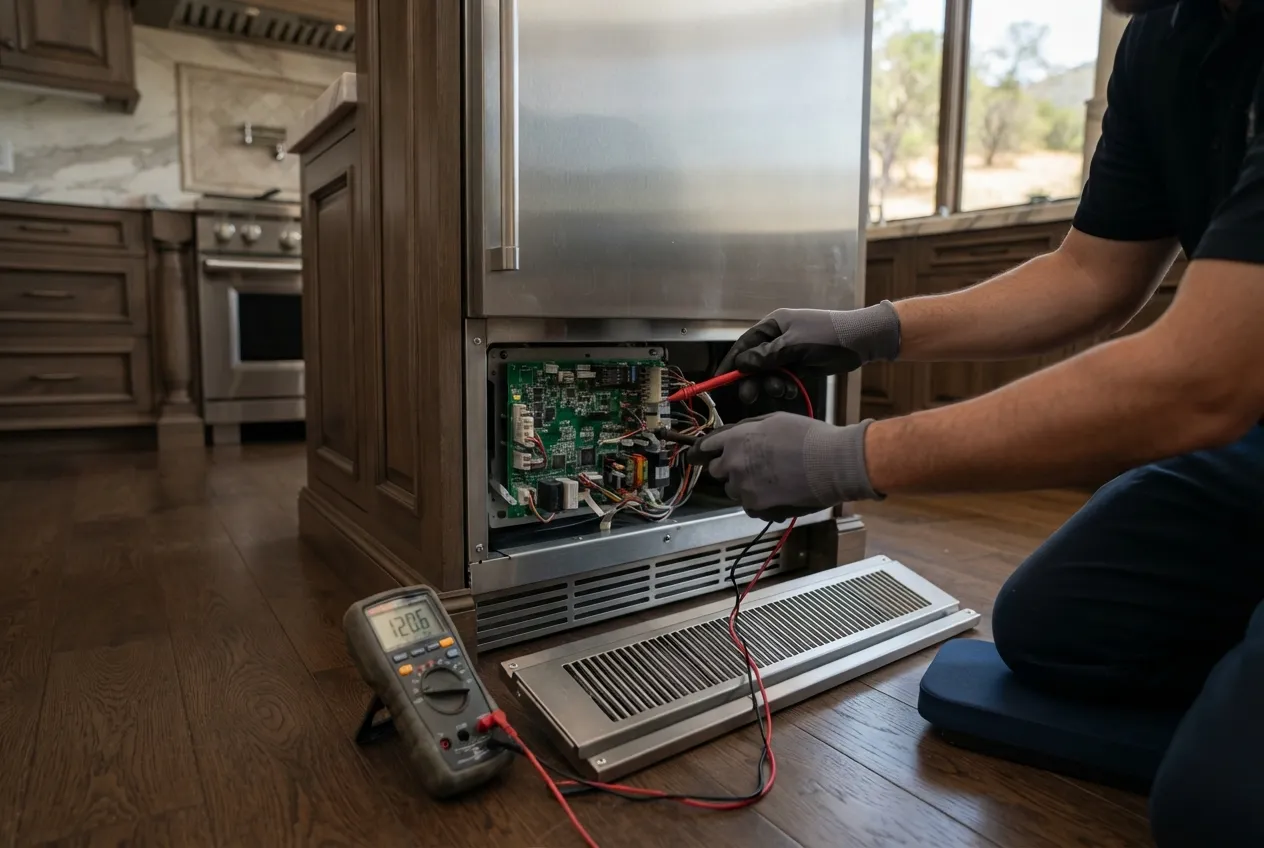
An ice maker only works when the water supply, the controls, and the cooling system all do their jobs. Our technician tests each of these in order rather than swapping parts until something works.
On built-in and panel-ready units, we also check the installation. We confirm the unit is level, look for a kinked or pinched supply line behind the cabinetry, and make sure the grille and ventilation path are clear. In the San Fernando Valley, summer heat makes a refrigerator's cooling system work harder than it would closer to the coast. A dusty condenser often shows up first as slow ice production.
- Water supply: the shutoff valve, the supply line, and water pressure at the unit
- Water filter: its age and flow rate. A clogged filter is one of the most common causes of small cubes.
- Water inlet valve: whether it opens fully and shuts off cleanly
- Fill tube: checking for ice blockages, which often come from a valve that drips
- Ice maker module: the ejector motor, mold heater, thermostat, and shutoff arm or bin sensor
- Freezer temperature and airflow, since an ice maker can't keep up if the freezer runs warm
- Condenser coil and fan: dust and lint that reduce cooling capacity
- On undercounter clear-ice machines: the evaporator plate, water pump, drain or drain pump, and mineral scale buildup
How Sub-Zero, Viking, Wolf and Thermador differ
Sub-Zero makes built-in and integrated refrigerators with ice makers in the freezer, as well as standalone undercounter ice machines. In the refrigerators, we often see worn inlet valves, frozen fill tubes, and ice maker modules that no longer complete a harvest cycle. The undercounter clear-ice models build ice in layers on a chilled plate. On those, scale buildup, the water pump, and the drain are the usual trouble spots, and regular cleaning makes a real difference.
Viking built-in refrigerators and undercounter ice machines share many of the same failure points: valves, modules, and drains. On older units, we often trace low output to a dirty condenser or a weak condenser fan.
Thermador column and built-in refrigeration places the ice maker inside a freezer column or drawer. Because these installations are tightly integrated, the supply line routing and access matter more. Faults in sensors or controls may show up as error codes rather than an obvious mechanical failure.
Wolf makes cooking appliances, not ice makers. Still, Wolf ranges and wall ovens often sit right next to Sub-Zero refrigeration. When we work in those kitchens, we confirm the refrigerator has the ventilation clearance its installation calls for. If your Wolf range or oven needs attention, we can diagnose it on the same visit.
Tell us what your appliance is doing.
Repair or replace on a high-end unit
Most ice maker failures can be fixed at the part level. A module, valve, pump, or sensor can usually be replaced without touching the rest of the refrigerator. That matters for built-in units, which are sized to a specific cabinet opening and often wear custom panels. Replacing the whole unit can mean matching that opening, refitting panels, and sometimes changing cabinetry.
Replacement starts to make sense when an older unit has a sealed-system failure, when key parts are no longer available, or when several major components are failing at once. If you rarely use ice, another option is to shut the ice maker off and keep the refrigerator running. We'll explain which situation you're in and let you decide.
What affects the cost
Every repair is quoted after diagnosis, because the cost depends on a few specific factors.
The first is the fault itself. Replacing a filter or clearing a frozen fill tube is a much smaller job than replacing an ice maker module or tracing a cooling problem. The second is parts. Genuine brand parts vary in cost and availability, and some have to be ordered. The third is access. A unit set into custom cabinetry may need panels removed or the refrigerator carefully pulled out, and an undercounter machine with a drain problem may require work in tight plumbing space. We explain each of these factors before any work begins.
How a visit works
When you schedule, tell us the brand, what you're seeing, and the model and serial number if you can find them. They're usually on a label inside the fresh-food section or behind the grille. This helps us bring the parts most likely to be needed.
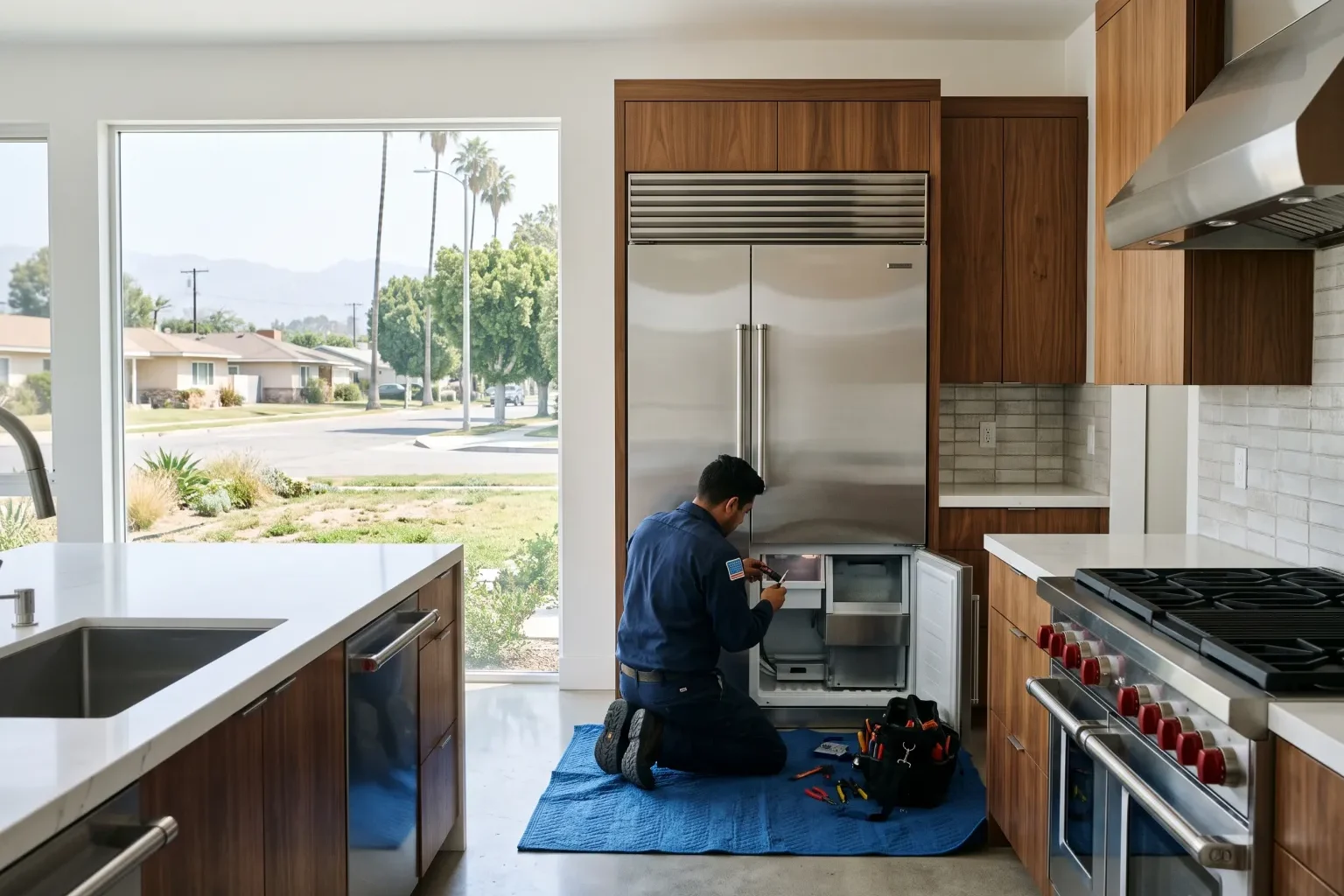
At the appointment, the technician diagnoses the problem, shows you what failed, and explains your options before starting any repair. If the part is on the truck, we can usually fix it the same day. If not, we order it and schedule a return visit. After the repair, we start a fill and harvest cycle to confirm water flows and the ice maker cycles correctly. It takes several hours to fill a bin, so we'll suggest throwing out the first batch or two of ice. Before we arrive, please empty the ice bin and clear space around the unit.