


The short answer
Most warming drawer problems come from a failed heating element, a faulty thermostat or sensor, a control issue, or worn glides and gaskets, and nearly all of them can be repaired. On a high-end built-in unit, repair is usually the better choice unless the drawer is very old, parts are no longer available, or the cabinet opening no longer fits current models.
A warming drawer is easy to forget until it stops working. Then dinner rolls come out cold, plates never warm up, or the drawer runs so hot it dries food out. Sub-Zero Appliance Experts repairs built-in and professional-style warming drawers in North Hollywood and the surrounding cities. We work in kitchens built around Sub-Zero refrigeration and Viking, Wolf and Thermador cooking equipment. Our technicians find the actual fault, explain it in plain terms, and fix it without tearing up your cabinetry. We are an independent repair company and are not affiliated with any appliance brand.
Issues we fix
Warming drawers have fewer parts than an oven, but each part matters. These are the problems homeowners call us about most often:
- Drawer doesn't heat at all, even with the indicator light on
- Uneven heat, with one side or the back staying cool
- Drawer runs too hot or won't hold the temperature you set
- Controls that won't respond, beep, or show an error
- Indicator light out or flickering
- Drawer that sticks, drags, sags, or won't close fully
- Push-to-open mechanism that no longer releases
- Torn or flattened door gasket letting heat escape
- Moisture control not working, so food turns soggy or dries out
- Burning smell or tripped breaker when the drawer is turned on
What our technician checks on a built-in unit
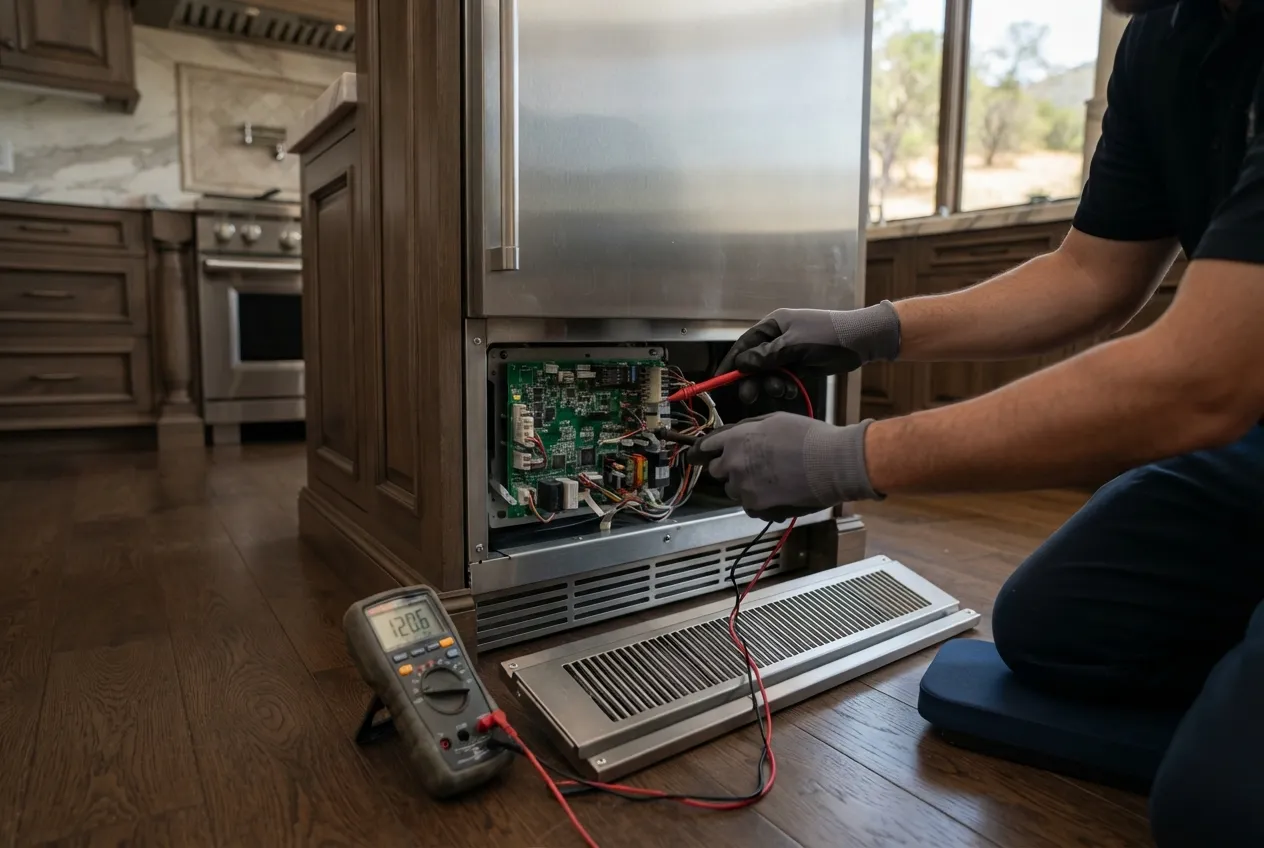
We start with the power supply and the circuit. A drawer that seems dead is sometimes a tripped breaker, a loose connection at the junction box, or a failed thermal fuse. Then we test the heating element for continuity and correct resistance. Elements often fail quietly, with no visible damage.
Next we check the thermostat or temperature sensor and compare the drawer's real temperature to the setting. On units with electronic controls, we look at the touch panel, the control board and the wiring harness between them. We also inspect the glides, rollers and mounting brackets, the door gasket, and the humidity vent or slider if your model has one.
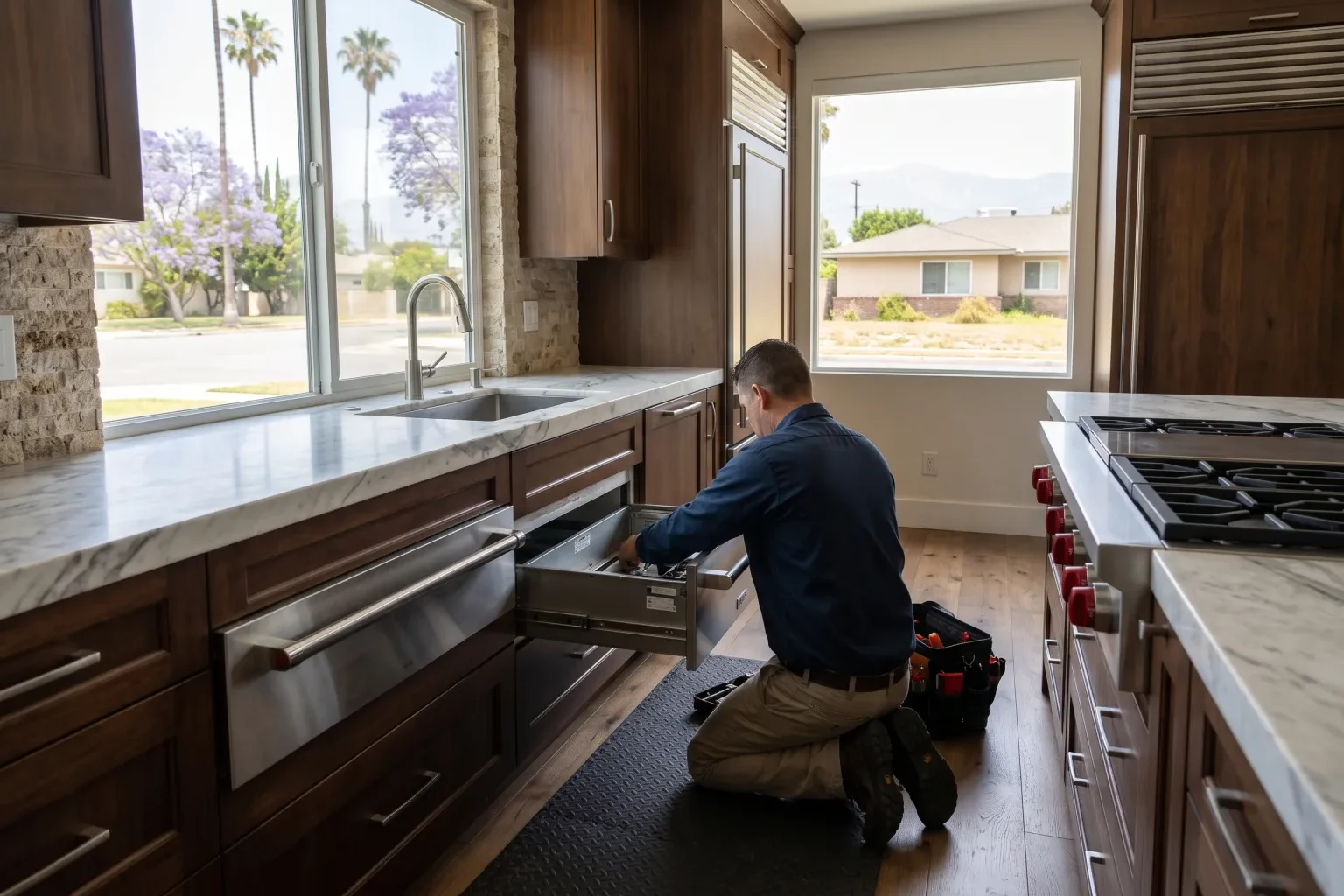
Built-in drawers sit tight in custom cabinetry, often under a wall oven or beside a range. We protect surrounding panels and floors, and we only pull the unit out when the repair calls for it.
How Sub-Zero, Viking, Wolf and Thermador drawers differ
Sub-Zero is known for refrigeration and doesn't build a warming drawer of its own. In a Sub-Zero kitchen, the drawer is usually a Wolf, a Viking or a Thermador. Many owners don't know the brand offhand. We can identify it from the model and serial tag, usually found on the drawer frame or side rail.
Wolf warming drawers come in styles meant to match its ovens and ranges, and many include a moisture setting. Problems we see there tend to involve the element, the temperature sensor, the control interface and the moisture vent. Viking drawers are common under professional-style ranges and wall ovens. Older Viking units in particular can develop worn glides, tired gaskets and failed thermostats after years of steady use.
Thermador warming drawers are often installed below wall ovens or steam ovens. Some use push-to-open fronts, so the latch mechanism and electronic controls get extra attention on those models. Across all brands, the specific failure depends more on age, how often the drawer is used, and how it was installed than on the name on the front.
Tell us what your appliance is doing.
Repair or replace a high-end warming drawer?
For most premium drawers, repair makes sense. The cabinet, the trim and often a custom panel were built around that unit. A failed element, sensor, gasket or set of glides is a contained repair that brings the drawer back to normal.
Replacement is worth discussing when the drawer is quite old, when a key part like the control board has been discontinued, or when several components are failing at once. Keep in mind that a new drawer may not match the old opening or your existing panel exactly. That can turn a simple swap into cabinet work. We will tell you honestly which way we would lean and why, and the decision stays yours.
What affects the cost of a repair
We give you a clear estimate after diagnosis, before any work begins. Several factors shape it.
The fault matters most. Replacing a gasket or adjusting glides is simpler than tracing an intermittent electronic problem. Parts come next. Elements and sensors are often stocked, while control boards and model-specific trim parts may need to be ordered. Age plays a role, since older parts can be harder to find. Access counts too. A drawer with a custom panel, tight reveals, or a unit stacked under a wall oven takes more care to remove and reinstall.
How a visit works
When you contact us, tell us the brand and model if you have them, describe what the drawer is doing, and mention any error codes or smells. That helps our technician arrive with the most likely parts.
On site, we diagnose the problem, walk you through what we found, and give you an estimate. If you approve and the part is on hand, we often complete the repair the same visit. If a part needs to be ordered, we schedule a return trip. Before we leave, we test the drawer at temperature and check that it opens and closes smoothly.